Introduction
SPARQL (SPARQL Protocol and RDF Query Language) is a query language for retrieving and manipulating data stored in RDF (Resource Description Framework) format. It enables precise querying of semantic data stored in triplestores, similar to how SQL queries relational databases.
|
SPARQL is the standard query language for RDF graphs, allowing users to extract and manipulate data in semantic web applications. It’s a critical component of Semantic Web Technologies (SWT) used in Digital Engineering (DE) workflows. |
Overview
SPARQL is a W3C standard query language designed specifically for querying RDF data stored in triplestores. Unlike SQL, SPARQL is built for graph-based data structures rather than tabular data, making it ideal for semantic web applications and knowledge graphs.
Key characteristics of SPARQL:
-
Designed for querying RDF graphs (subject-predicate-object triples)
-
Supports pattern matching across graph structures
-
Returns both explicitly stored data and inferred data (when reasoning is enabled)
-
Provides five main query types for different operations on RDF data
-
Can be used for both querying and modifying data in triplestores
|
SPARQL’s ability to return both explicitly stored data and inferred data (through OWL reasoning) makes it uniquely powerful for semantic applications, allowing users to work with the complete knowledge base rather than just the explicitly stated facts. |
Position in Knowledge Hierarchy
Broader concepts: - Part IV (is-a)
Details
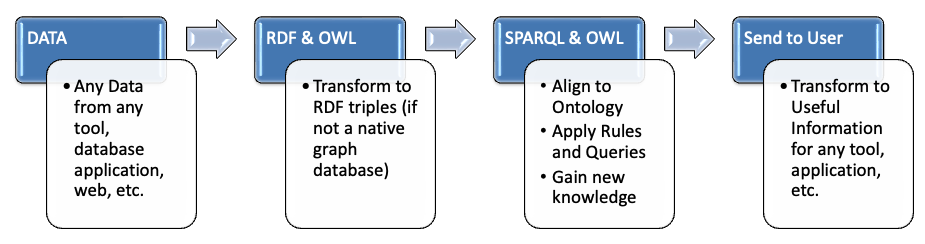
SPARQL is a key component of Semantic Web Technologies (SWT) used in Digital Engineering (DE) workflows. It serves as the primary interface for interacting with RDF triplestores, enabling both data retrieval and modification operations.
Query Types
SPARQL supports five main query types, each serving a specific purpose in data manipulation:
Query Type |
Purpose |
|
Retrieve data based on a query pattern |
|
Answer a true/false question about data in the repository |
|
Return RDF triples built from a provided form and query pattern |
|
Add new triples to the repository based on a provided form and query pattern |
|
Remove triples from the repository based on a provided form and query pattern |
Query Structure
A basic SPARQL query follows a pattern that matches triple patterns in the RDF graph:
SELECT ?subject ?predicate ?object
WHERE {
  ?subject ?predicate ?object
}
This query returns all triples in the repository. The ? prefix denotes variables that will be bound to values from the data.
SPARQL Syntax
SPARQL syntax uses a pattern-based approach to match data in the graph. It’s similar to SQL but adapted for graph structures:
-
Triple patterns:
?subject ?predicate ?object -
Variable bindings:
?variable -
Filter conditions:
FILTER (condition) -
Ordering:
ORDER BY ?variable -
Limiting results:
LIMIT 10
|
SPARQL queries are case-sensitive, and the use of prefixes (e.g., |
SPARQL in Triplestore Environments
Triplestores (semantic databases) provide SPARQL endpoints for querying and manipulating RDF data. The workflow typically involves:
-
Connecting to a triplestore endpoint
-
Executing SPARQL queries
-
Processing results
-
Optionally modifying the data
|
When using SPARQL to modify data (INSERT/DELETE), ensure proper transaction management to maintain data integrity. Unlike SQL, SPARQL’s data modification operations are typically not transactional by default in many triplestore implementations. |
Practical applications and examples
SPARQL is widely used in Digital Engineering (DE) workflows to query and manipulate ontology-aligned data. Here are practical examples based on the context provided:
Basic Query Example
A simple SPARQL query to find all predicates in a triplestore:
SELECT DISTINCT ?predicate
WHERE {
  ?subject ?predicate ?object
}
ORDER BY ?predicate
This query returns a list of unique predicates used in the repository, ordered alphabetically.
Data Retrieval in IoIF Workflow
In the IoIF (Armaments Interoperability and Integration Framework) workflow, SPARQL is used to pull data from triplestores for analysis:
SELECT ?catapult ?armLength
WHERE {
  ?catapult a <http://example.org/Catapult> .
  ?catapult <http://example.org/hasArmLength> ?armLength .
}
This query retrieves all catapults and their arm lengths from the ontology-aligned data.
Data Modification Example
SPARQL can also be used to modify data in the triplestore:
INSERT DATA {
  <http://example.org/Catapult1> <http://example.org/hasArmLength> "2.5" .
}
This inserts a new triple representing a catapult’s arm length.
Graph-Based Analysis
For the Semantic System Verification Layer (SSVL), SPARQL is used to extract subgraphs for analysis:
CONSTRUCT {
  ?subject ?predicate ?object
}
WHERE {
  ?subject ?predicate ?object .
  FILTER (CONTAINS(STR(?subject), "Catapult"))
}
This query constructs a subgraph containing all triples related to catapults.
|
When using SPARQL for graph-based analysis, it’s common to first extract the relevant subgraph using a CONSTRUCT query, then apply graph algorithms to the extracted data. |
Related wiki pages
References
SPARQL Relationships
Associated Diagrams