Introduction
The Digital Engineering (DE) Ecosystem is an integrated environment of tools, methods, and data that enables modern engineering practices. Think of it as the "operating system" for digital engineering, where different tools and data sources work together seamlessly to support the entire product lifecycle.
|
The DE Ecosystem isn’t just about technology—it’s about how people, processes, and technology work together to create better engineering outcomes. |
Overview
The Digital Engineering Ecosystem represents a holistic approach to engineering that integrates modeling, simulation, data management, and collaboration across the entire system lifecycle. It’s not merely a collection of tools, but a coordinated environment where data flows freely between different disciplines and tools, enabling better decision-making, reduced development time, and improved system performance.
|
The DE Ecosystem emphasizes the importance of interoperability, where different tools and data sources can communicate effectively without manual intervention or data translation. |
The ecosystem is structured around three key components that work together:
| Component | Description |
|---|---|
Data |
Ontology-aligned data that provides semantic meaning and context to engineering information |
Tools |
Modeling, simulation, and analysis tools that leverage the data |
Methods |
Processes and workflows that govern how data is used and shared across the ecosystem |
The Digital Engineering Ecosystem is enabled by the Digital Engineering Framework for Integration and Interoperability (DEFII), which provides a structured approach to integrating these components.
|
The DE Ecosystem is not a single tool or platform, but rather a coordinated approach to integrating existing tools and data through semantic technologies and interoperability frameworks. |
Position in Knowledge Hierarchy
Broader concepts: - Digital Engineering (part-of)
Details
Core Components of the DE Ecosystem
The DE Ecosystem consists of several interconnected components that work together to enable digital engineering practices:
Component |
Description |
Modeling and Simulation Capabilities |
Discipline-specific models (FEA, CFD, 6DOF, etc.) and system-level models that describe how systems work |
Methodologies |
Processes and workflows (e.g., NAVSEM, ISEDM) that guide how engineering work is performed |
Data Management |
Ontology-aligned data repositories (triplestores) that provide semantic context to engineering information |
Semantic Web Technologies (SWT) |
Technologies like OWL, RDF, SPARQL, and reasoning engines that enable semantic interoperability |
Interoperability Frameworks |
Frameworks like DEFII and IoIF that provide the structure for integrating tools and data |
The Role of Ontologies in the DE Ecosystem
Ontologies serve as the "common language" of the DE Ecosystem. They provide a formal, machine-readable representation of domain knowledge that enables different tools and systems to understand and exchange data consistently.
|
Without ontologies, the DE Ecosystem would be like a room full of people speaking different languages—communication would be difficult and error-prone. |
The DE Ecosystem uses a layered approach to ontologies:
-
Top-level ontologies (TLOs) like Basic Formal Ontology (BFO) provide foundational concepts
-
Mid-level ontologies like Common Core Ontologies (CCO) provide domain-agnostic concepts
-
Domain-specific ontologies provide detailed concepts for specific engineering domains
|
The DE Ecosystem relies on the "Authoritative Source of Truth" (ASOT) concept, where ontology-aligned data serves as the single, trusted source for engineering information across all tools and stakeholders. |
DEFII Framework as the Foundation
The Digital Engineering Framework for Integration and Interoperability (DEFII) provides the structure for the DE Ecosystem. It has three basic layers:
Layer |
Description |
Ontology-aligned data |
Foundation of the framework, where data is aligned to ontologies for semantic meaning |
Automated reasoning |
Enriches data using axioms and rules defined in ontologies |
Tool proxy interfaces |
Mechanisms for different tools to interact with the ontology-aligned data |
The DEFII framework is implemented through the Armaments Interoperability and Integration Framework (IoIF), which provides the practical implementation for integrating tools and data in the DE Ecosystem.
|
The DE Ecosystem requires careful planning and governance. Without proper ontology alignment and data management, the ecosystem can become fragmented and fail to deliver on its promise of interoperability. |
Practical applications and examples
Catapult Example
The Catapult use case demonstrates how the DE Ecosystem works in practice. This example shows how different engineering disciplines work together using a unified data model:
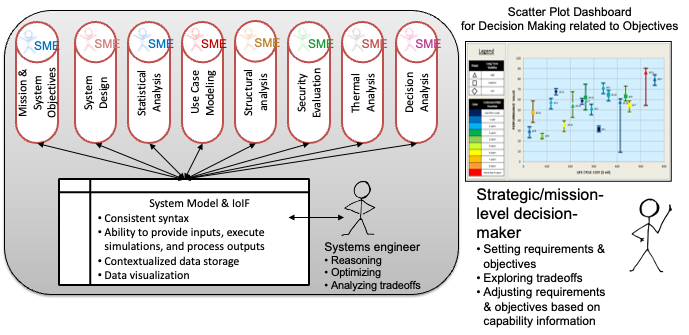
The Catapult example uses the IoIF framework to integrate different analysis tools through the ontology-aligned data repository. Each analysis tool (geometry, ballistics, thermal, 6DOF) connects to the IoIF framework, which manages the data flow between them and provides a unified view through dashboards.
|
In this example, the IoIF framework uses the Assessment Flow Diagram (AFD) to define the relationships between different analysis models and the system under analysis. |
Workflow in the DE Ecosystem
A typical workflow in the DE Ecosystem involves these steps:
-
Model creation: Create a SysML model with an Assessment Flow Diagram (AFD) that defines the analysis workflow
-
Ontology alignment: Tag model elements with ontology classes using SysML stereotypes
-
Data integration: Use tool proxies to pull data from different modeling tools into the ontology-aligned repository
-
Analysis execution: Run simulations and analyses using the integrated data
-
Visualization: View results through dashboards that show trade-offs and impacts
|
The DE Ecosystem requires proper configuration of the ontology-aligned data repository. Without proper ontology alignment, the system will not be able to correctly interpret and integrate data from different tools. |
Related wiki pages
References
DE Ecosystem Visualization
Associated Diagrams