Introduction
A top-level ontology (TLO) is the foundational structure that defines the most basic categories of things that exist in the world, serving as a consistent framework for building more specific ontologies.
Overview
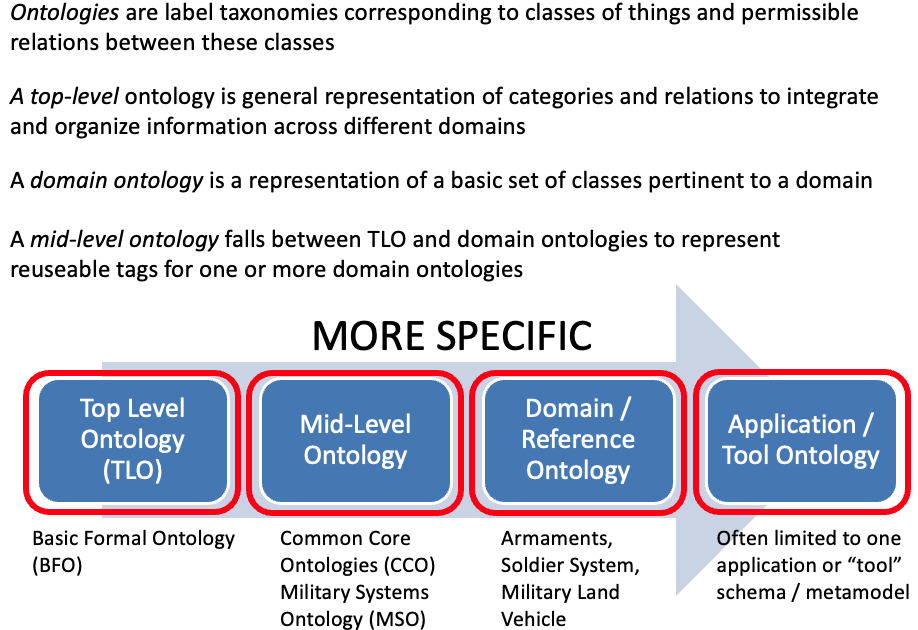
Top-level ontologies (TLOs) provide the philosophical and structural foundation for all other ontologies within an ontology ecosystem. They establish a small set of high-level classes that represent fundamental categories of existence, enabling consistency and interoperability across domain-specific ontologies.
TLOs serve as the "operating system" for ontology development projects, determining key aspects of the look, feel, and function of the resulting ecosystem. They provide a disciplined framework that makes ontologies more likely to succeed at digital engineering (DE) tasks and promote interoperability.
|
TLOs should be small (typically with tens of terms), well-documented, and adhere to formalized axioms. They should avoid straying into specific domains and instead focus on high-level philosophical questions about the nature of existence. |
|
The selection of a TLO is an engineering decision, not a philosophical debate. The most important consideration is choosing an existing TLO that fits your needs rather than creating a new one. |
Position in Knowledge Hierarchy
Broader concepts: - Ontology (is-a)
Details
Characteristics of a Good TLO
A good TLO should possess the following characteristics:
Characteristic |
Description |
Small size |
Typically contains tens of terms outlining major types of things in the world |
High-level focus |
Deals with philosophical notions rather than domain-specific details |
Well-documented |
Includes clear principles for extension and formalized axioms |
Stable ecosystem |
Part of a well-established ecosystem with reference ontologies |
Openly distributed |
Available via stable, reputable online repositories |
Interoperable |
Designed for reuse across multiple ontology projects |
TLO Structure and Taxonomy
TLOs typically organize the world into a small number of fundamental categories. For example, the Basic Formal Ontology (BFO) organizes reality into two main perspectives:
Category |
Description |
Continuants |
Things whose identity persists across time (e.g., objects, information, qualities) |
Occurrents |
Things that happen or unfold in time (e.g., events, processes, actions) |
Within these categories, BFO further organizes concepts into a hierarchical taxonomy with single inheritance paths to ensure predictable reasoning behavior. This structure allows for:
-
Clear taxonomic reasoning (e.g., "if something is a Car, it is also a Vehicle")
-
Consistent application of logical axioms
-
Predictable query behavior across the ontology ecosystem
|
BFO’s taxonomy ensures that every class has a single path of inheritance to the most general class (entity), making the behavior of BFO-aligned data and reasoning far more predictable than complex ontologies with multiple inheritance paths. |
TLO Selection Process
When selecting a TLO for your project, consider:
-
Existing ecosystem: Choose a TLO with a well-established ecosystem of reference ontologies
-
Documentation: Ensure the TLO has clear development guidelines and examples
-
Philosophical alignment: Consider whether the TLO’s philosophical underpinnings align with your domain
-
Community support: Look for active communities and existing implementations
|
Avoid creating a new TLO from scratch. The creation of TLOs is a specialist skill beyond most domain ontology development efforts, and interoperability requires reuse of existing work. |
Practical applications and examples
BFO as a TLO
The Basic Formal Ontology (BFO) is the most commonly used TLO in the digital engineering domain. It serves as the foundation for the IoIF framework and other engineering ontology efforts.
BFO provides a small set of high-level classes that represent fundamental categories of existence, including:
-
Entity (the root class)
-
Continuant (things that persist through time)
-
Independent continuant (e.g., objects)
-
Dependent continuant (e.g., roles, qualities)
-
Generically dependent continuant (e.g., information)
-
Occurrent (things that happen over time)
-
Process (e.g., actions, events)
-
Temporal region (e.g., time spans)
|
BFO’s small size (around 100 classes) and focus on high-level philosophical concepts make it an ideal foundation for engineering ontologies. It avoids domain-specific details while providing a consistent framework for building more specific ontologies. |
TLO in Ontology Ecosystems
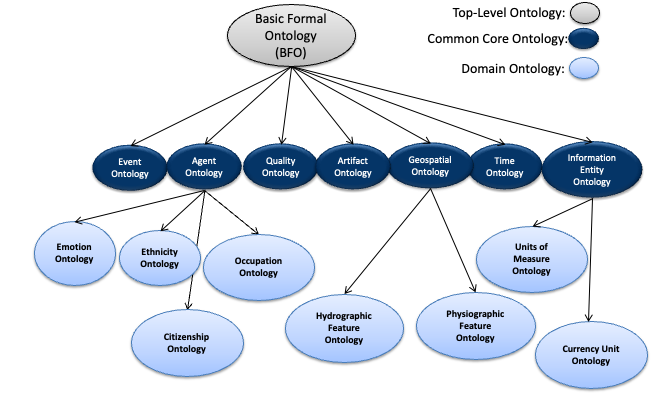
TLOs form the foundation of ontology ecosystems, which typically include:
-
Top-level ontology (TLO) - The foundational structure (e.g., BFO)
-
Mid-level ontologies (MLO) - Bridge the gap between TLO and domain terminology (e.g., Common Core Ontology - CCO)
-
Domain ontologies (DO) - Describe specific domains (e.g., armaments, aviation)
-
Application ontologies - Align with specific tools or use cases
|
When developing an ontology, always align it with an existing TLO. This ensures coherence and compatibility with other ontologies, enabling interoperability across domains. |
Implementing a TLO in Practice
To implement a TLO in your ontology development workflow:
-
Select a TLO (e.g., BFO) that fits your needs
-
Import the TLO into your ontology editor (e.g., Protégé)
-
Use the TLO’s classes and relations as the foundation for your domain ontology
-
Extend the TLO with domain-specific terms while preserving its structure
|
When creating a new ontology, start by importing the TLO and then add domain-specific classes that extend from the TLO’s classes. For example, in Protégé: 1. Open Protégé 2. Create a new ontology 3. Import the BFO ontology (File > Import > OWL) 4. Create new classes that extend BFO’s classes |
Related wiki pages
References
TLO Ecosystem Visualization
Associated Diagrams