Introduction
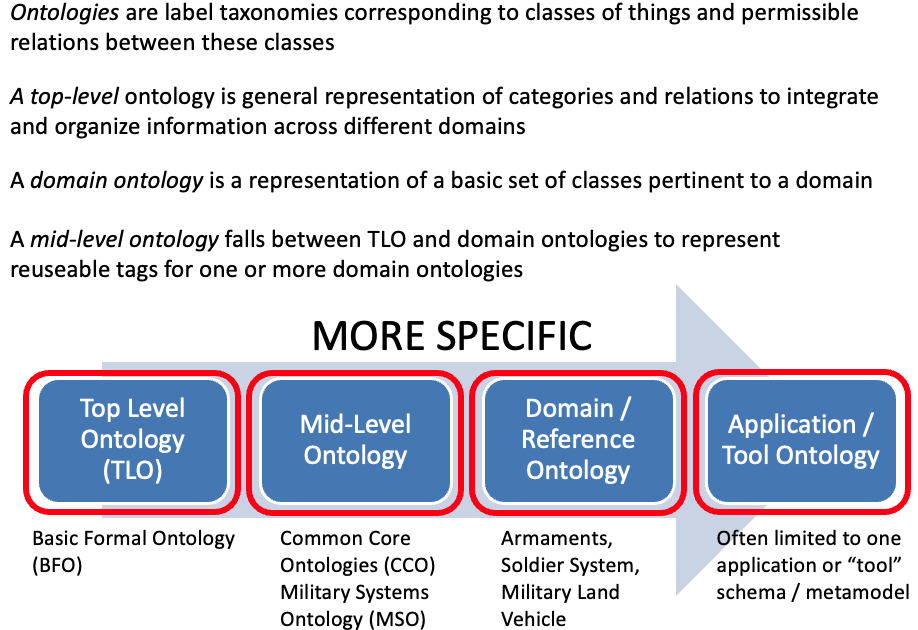
A Mid-level Ontology (MLO) bridges the gap between top-level ontologies and domain-specific ontologies, providing reusable foundational concepts that are more specific than top-level ontologies but more general than domain ontologies.
Overview
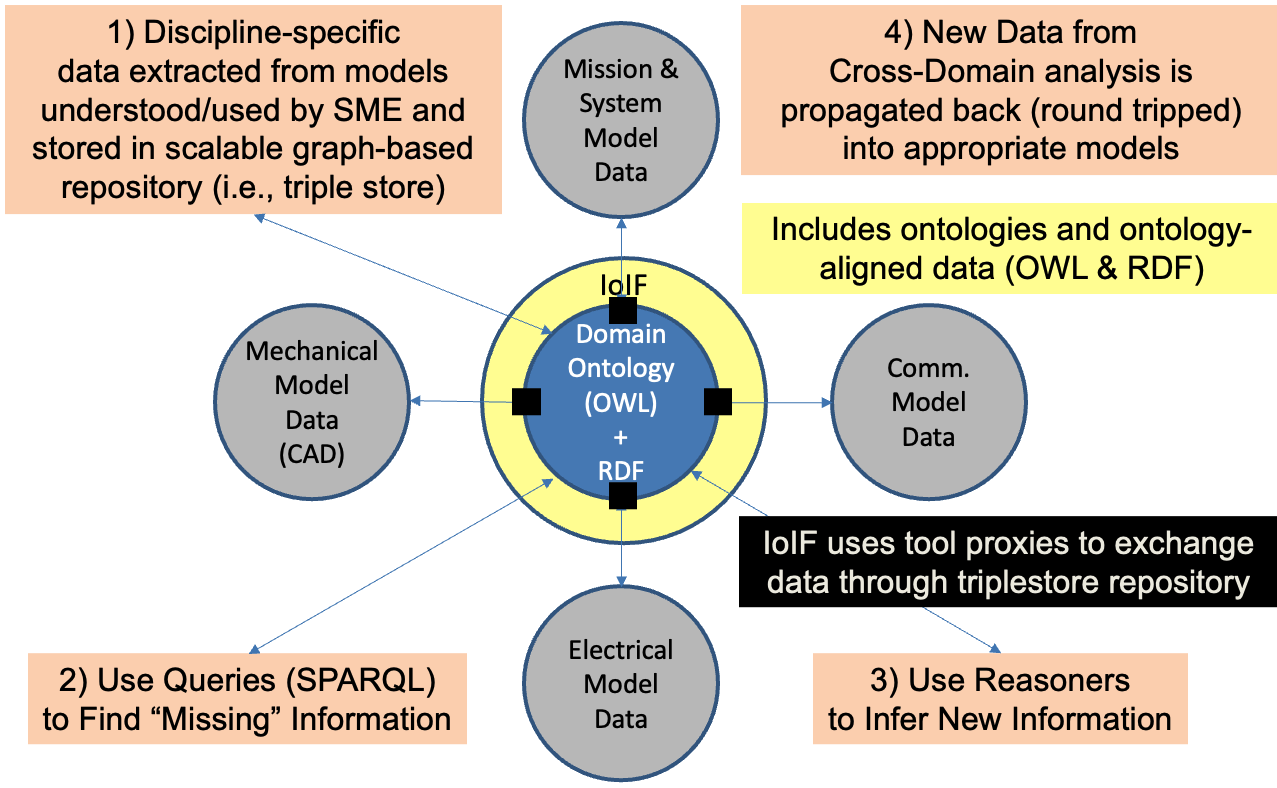
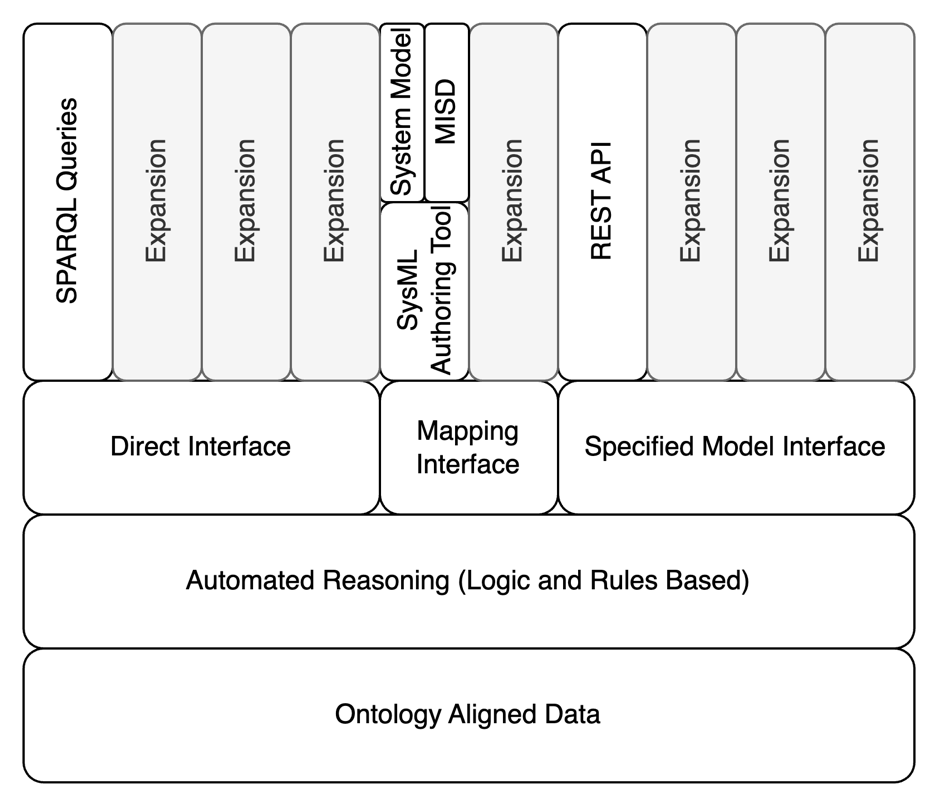
MLOs serve as a crucial layer in the ontology ecosystem, enabling interoperability between high-level philosophical foundations and specific domain knowledge. They provide a common vocabulary and structure that can be reused across multiple domains, reducing the need for redundant ontology development. In the context of Digital Engineering (DE) and the Armaments Interoperability and Integration Framework (IoIF), MLOs like the Common Core Ontology (CCO) play a vital role in enabling cross-domain interoperability.
| The line between a mid-level ontology and a domain ontology is not concrete; it’s a matter of perspective. For example, decision-making terms might be considered a domain ontology in one context but a mid-level ontology in another, depending on the scope of the project. |
Position in Knowledge Hierarchy
Broader concepts: - Ontology (is-a)
Details
MLOs are characterized by:
-
Bridging the gap: Providing a middle layer between the high-level philosophical concepts of TLOs and the specific terminology of domain ontologies
-
Reusability: Designed to be reused across multiple domains, reducing redundant ontology development
-
Abstraction level: More specific than TLOs but more general than domain ontologies
-
Domain neutrality: While more specific than TLOs, MLOs remain relatively domain-neutral
Types of Ontologies in the Ecosystem
Ontology Type |
Purpose |
Example |
TLO (Top-Level Ontology) |
Provides philosophical foundations for the entire ontology ecosystem |
BFO (Basic Formal Ontology) |
MLO (Mid-level Ontology) |
Bridges TLO and domain ontologies; provides reusable foundational concepts |
CCO (Common Core Ontology) |
DO (Domain Ontology) |
Describes domain-specific concepts |
Armaments, Aviation Vehicles |
Application Ontology |
Aligns with DE tool metamodels |
SysML-based ontologies for specific engineering tools |
| MLOs like the CCO are formalized using a TLO (typically BFO) and provide a foundation that domain ontologies can extend. This ensures coherence and compatibility across the entire ontology ecosystem. |
Key Characteristics of MLOs
-
Reusability: MLOs are designed to be reused across multiple domains, reducing redundant ontology development
-
Abstraction Level: More specific than TLOs but more general than domain ontologies
-
Foundation for Domain Ontologies: Provide a common base that domain ontologies can extend
-
Support for SMEs: Contain basic treatments of concepts like actions, events, and information that are familiar to subject matter experts
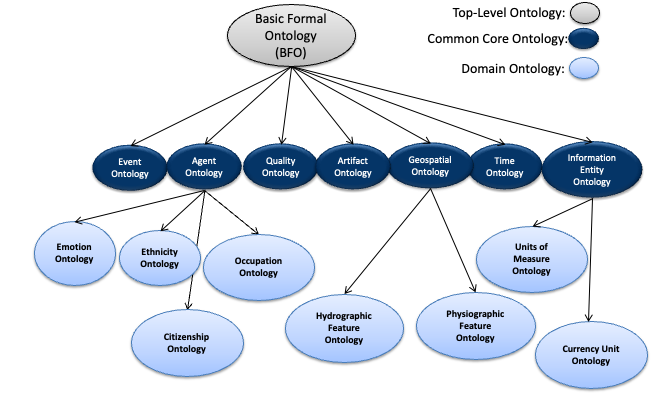
| The CCO (Common Core Ontology) is a prominent example of an MLO that comprises twelve ontologies aiming to represent and integrate taxonomies of generic classes and relations across all domains of interest. |
Practical applications and examples
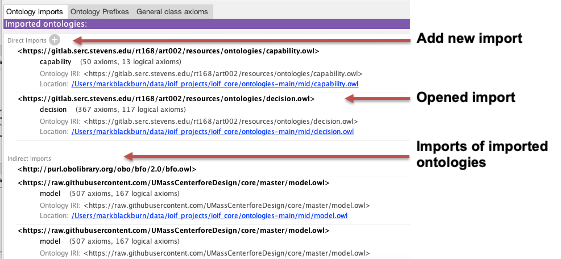
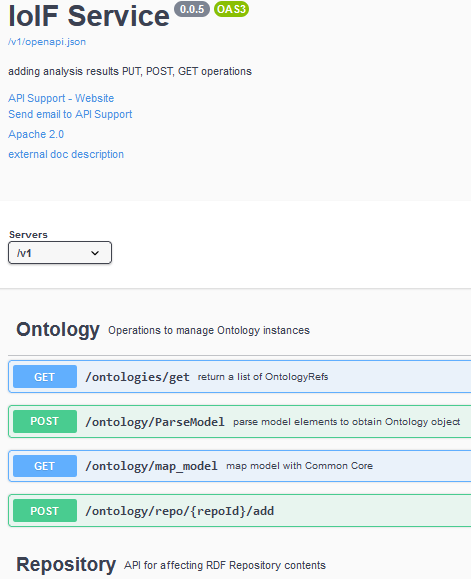
MLOs are used extensively in the IoIF (Armaments Interoperability and Integration Framework) to enable interoperability across different engineering domains. The CCO serves as a key MLO that provides reusable components for domain-specific ontologies.
Example: CCO in IoIF
The CCO serves as a mid-level ontology that provides a foundation for domain-specific ontologies used in the IoIF framework. It contains generic classes and relations that can be reused across different engineering domains, such as:
-
Classes: Person, Act of Communication, Geopolitical Entity
-
Relations: hasRole, hasPurpose, isPartOf
When developing a domain ontology for armaments, the CCO provides a starting point with its generic concepts, which can then be specialized for the specific needs of the armaments domain.
| The CCO is formalized using BFO (a TLO) and is designed to be used with the BFO ecosystem. It’s not meant to be a complete ontology for any single domain, but rather a set of reusable components that can be combined with domain-specific ontologies. |
Implementation in IoIF
In the IoIF framework, MLOs are integrated as follows:
-
The TLO (BFO) provides the foundational philosophical framework
-
The MLO (CCO) provides reusable concepts that bridge the TLO and domain-specific needs
-
Domain ontologies build upon the MLO for specific engineering domains
-
Application ontologies align with DE tools like SysML
| When developing an MLO, it’s critical to adhere to the principles of the TLO (e.g., BFO) to ensure coherence and compatibility with the broader ontology ecosystem. Failure to do so can lead to interoperability issues when integrating with other ontologies. |
Related wiki pages
References
Knowledge Graph
Associated Diagrams