Introduction
The TBox is the part of an ontology that defines the vocabulary and logical structure of a domain. Think of it as the dictionary and grammar rules for a specialized language used to describe a specific field of knowledge.
Overview
The Terminology Box (TBox) is the core component of an ontology that contains all the definitions and logical structure for a domain. It defines: - The types of things (classes) - The relationships between those things (properties) - The constraints that govern how those relationships work
The TBox is the reusable part of an ontology that can be applied to multiple datasets. It’s the foundation that enables interoperability across different systems and tools.
| The TBox is the part of the ontology that is developed first, before any specific data is added. It defines the framework that the data will follow. |
| The TBox is typically created using ontology authoring tools like Protégé and serialized in OWL format for machine readability. |
Position in Knowledge Hierarchy
Broader concepts: - Ontology (part-of)
Details
The TBox is the part of an ontology that defines the "what" - the concepts and relationships in a domain. It’s built using formal logic and structured as a taxonomy of classes and properties.
Key Components of the TBox
The TBox consists of several key components that work together to define a domain:
Component |
Description |
Classes |
Types of things in the domain (e.g., Vehicle, Car, GroundVehicle) |
Subclass Relationships |
Hierarchical relationships between classes (e.g., Car subClassOf GroundVehicle) |
Properties |
Relationships between classes (e.g., hasPart, hasColor) |
Restrictions |
Logical constraints on classes (e.g., a Car must have exactly 4 wheels) |
TBox Construction Principles
When constructing a TBox, it’s important to follow these principles:
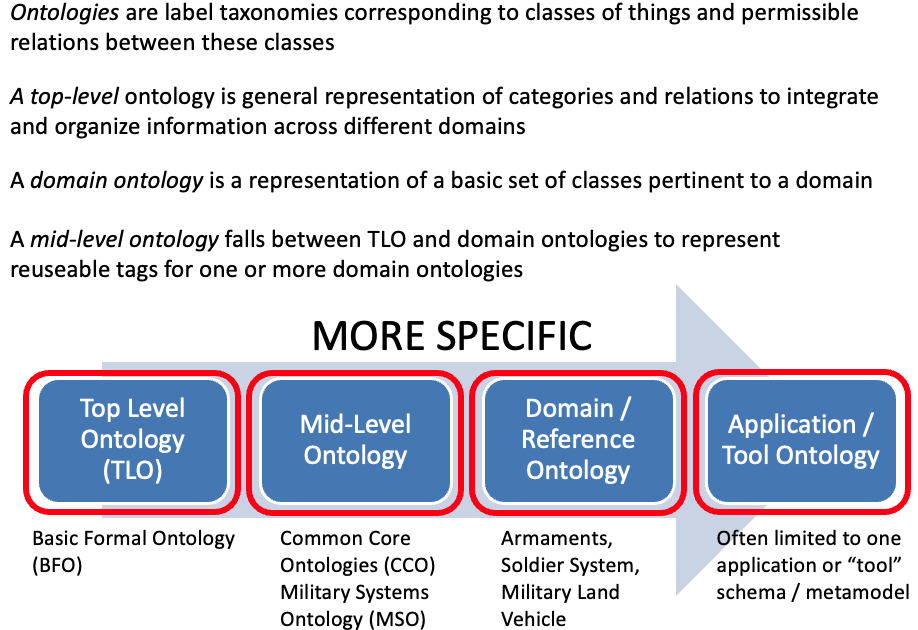
| The TBox should be built using a top-level ontology (TLO) as a foundation to ensure consistency and interoperability with other ontologies. |
-
Consistency: The TBox should not contradict itself or known facts about the domain.
-
Coherence: The TBox should be logically consistent with the philosophical underpinnings of the chosen TLO.
-
Reusability: The TBox should be designed to be reused across multiple applications and datasets.
-
Precision: The definitions and relationships should be specific enough to be useful but not so specific as to be inflexible.
| When defining subclass relationships, be careful not to violate the single classification principle (BFO’s principle that an instance can only belong to one subclass at a time). |
TBox vs. ABox
The TBox and ABox are complementary parts of an ontology:
TBox |
ABox |
Defines the vocabulary and logical structure |
Contains specific instances of the vocabulary |
The "what" (concepts and relationships) |
The "who" (specific examples) |
Reusable across multiple datasets |
Specific to a particular dataset |
Contains class definitions and constraints |
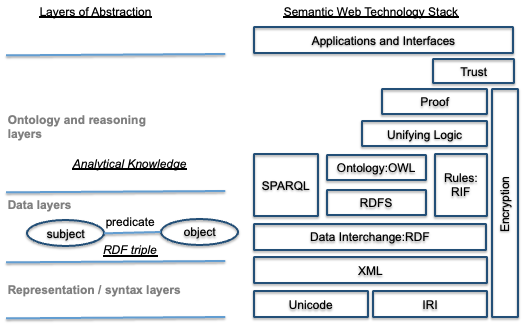
Contains triples (subject-predicate-object) about specific instances |
Example: "Car is a subclass of GroundVehicle" |
Example: "MyCar is a Car" |
| The TBox and ABox must be kept in sync. Changes to the TBox (like adding a new class) can affect how the ABox is interpreted and queried. |
Practical applications and examples
Let’s look at a practical example of a TBox for a vehicle ontology using OWL syntax:
= Vehicle ontology TBox
@prefix : <http://example.org/vehicle#> .
@prefix owl: <http://www.w3.org/2002/07/owl#> .
@prefix rdf: <http://www.w3.org/1999/02/22-rdf-syntax-ns#> .
@prefix rdfs: <http://www.w3.org/2000/01/rdf-schema#> .

= Classes
:Vehicle a owl:Class .
:GroundVehicle a owl:Class ;
    rdfs:subClassOf :Vehicle .
:Car a owl:Class ;
    rdfs:subClassOf :GroundVehicle .

= Properties
:hasPart a owl:ObjectProperty ;
    rdfs:domain :Vehicle ;
    rdfs:range :Part .

= Restrictions
:Car a owl:Class ;
    owl:equivalentClass [
        a owl:Class ;
        owl:intersectionOf (
            :Car
            [
                a owl:Restriction ;
                owl:onProperty :hasPart ;
                owl:hasValue :Wheel
            ]
        )
    ] .
This TBox defines: - A hierarchy of vehicle types (Vehicle > GroundVehicle > Car) - A property "hasPart" that relates vehicles to parts - A restriction that says a Car must have a Wheel as a part
| In the context of the DEFII framework and IoIF, the TBox is used to define the domain ontologies that enable interoperability across different engineering tools. |
| When implementing a TBox in a real-world engineering context, it’s crucial to align with a top-level ontology like BFO to ensure compatibility with other ontologies and systems. |
Related wiki pages
References
Knowledge Graph
Visualize the TBox within the ontology structure
Associated Diagrams