Introduction
Stereotypes are special metadata tags in SysML that connect model elements to ontology classes, enabling systems engineers to integrate model-based systems engineering with semantic knowledge representations.
Overview
Stereotypes in SysML serve as metadata tags that bridge SysML models with ontologies, enabling ontology-aligned data integration within the Armaments Interoperability and Integration Framework (IoIF). They provide a standardized mechanism for:
-
Indicating which ontology class corresponds to a model element
-
Enabling retrofits of existing models for IoIF integration
-
Delineating model elements relevant to the digital thread
Stereotypes are a critical component of ontology alignment in digital engineering, allowing SysML models to be interpreted by ontology-based reasoning systems. They represent the metadata mechanism used in SysML v1, while SysML v2 uses a more formal metadata construct for the same purpose.
|
Stereotypes must be applied consistently and with descriptive names to ensure readability and maintainability of models. The metadata application must be repeatable and clearly distinguishable from standard model metadata. |
Position in Knowledge Hierarchy
Broader concepts: - Ontology Alignment (is-a)
Details
Stereotype Structure and Syntax
Stereotypes in SysML follow this format:
<<stereotype-name>>Where stereotype-name corresponds to an ontology class name. For example:
Catapult System <<catapult>>This syntax indicates that the "Catapult System" element should be associated with the "catapult" ontology class.
|
The stereotype name must match the ontology class name exactly or follow a consistent naming convention established for the ontology to ensure proper alignment. |
Ontology Alignment Principles
When applying stereotypes, the following principles should be followed:
Principle |
Description |
Descriptive Naming |
Use clear, descriptive names that match ontology classes (e.g., [weapon_system] instead of [ws]) |
Consistency |
Apply stereotypes consistently across similar model elements |
Reusability |
Create stereotypes that can be reused across multiple models and projects |
Ontology Alignment |
Ensure stereotypes map to appropriate ontology classes as per alignment principles |
Stereotype Implementation in SysML Tools
Stereotypes can be implemented in various SysML modeling tools. The following table shows common tools and their stereotype implementation approaches:
Tool |
Stereotype Implementation |
MagicDraw/Cameo Systems Modeler |
Uses a "Stereotype" tab in the properties panel to apply and manage stereotypes |
SysML v1 Tools |
Uses the stereotype mechanism with [stereotype] syntax |
SysML v2 Tools |
Uses the metadata construct for tagging model elements |
Protege (for ontology development) |
Used to define the ontology classes that stereotypes map to |
Practical applications and examples
Example: Catapult System with Stereotypes
Here’s how to apply stereotypes to a Catapult system model to align it with an ontology:
Step 1: Define the ontology class In Protégé, create a class for "Catapult" under the appropriate ontology namespace:
Catapult
  - Subclass of: PhysicalObject
  - Definition: A mechanical device for launching projectiles
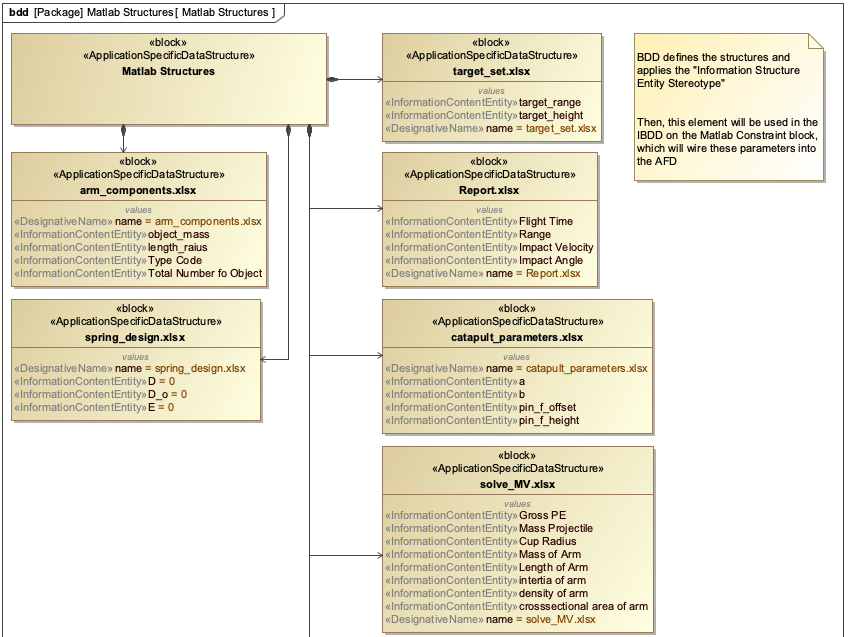
Step 2: Apply the stereotype to the SysML model In the SysML modeling tool, create a Block Definition Diagram (BDD) for the Catapult system. Add a block for "Catapult System" and apply the stereotype:
Catapult System <<catapult>>Step 3: Verify the alignment Use IoIF to load the SysML model and verify that the stereotype maps correctly to the ontology class. The IoIF workflow should recognize the "catapult" stereotype and associate the model element with the ontology class.
|
Avoid creating stereotypes that duplicate existing ontology classes or use inconsistent naming conventions. This can lead to alignment issues and reduce the effectiveness of the ontology integration. |
Stereotype Profile for a Mission Model
Consider a mission model that needs to be aligned with an ontology for military operations. The following stereotype profile would be created:
Stereotype Name |
Corresponding Ontology Class |
Mission |
|
Objective |
|
Capability |
|
Environment |
|
Actor |
Then, in the SysML model:
Mission <<mission>>
  - Objective "Hitting the target" <<objective>>
  - Capability "Projectile Launch" <<capability>>
  - Environment "Open Field" <<environment>>
- Actor "Soldier" <<actor>>References
Knowledge Graph
Visualize the relationships between stereotypes and related concepts
Associated Diagrams